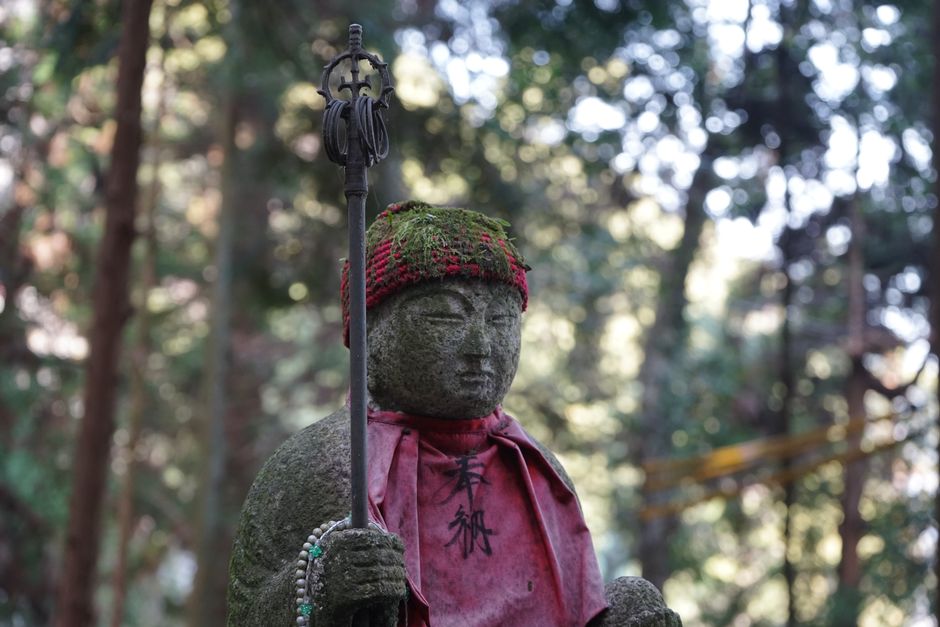

Kōbō Daishi and the Shingon foundation
The monk Kōbō Daishi (774–835), born Saeki no Mamoru, is one of Japan’s greatest religious figures. He:
- Studied Buddhism in China for 20 years (804–806).
- Introduced Shingon Buddhism (Vajrayana, “true words”) to Japan.
- Created the Japanese kana alphabet (hiragana).
- Founded Mount Kōya in 816.
- Served at the court of Emperor Saga.
Kōbō Daishi (also known as Kūkai, “sea of emptiness”) died in 835 and is traditionally believed to remain in eternal meditation in the Okunoin mausoleum. See our guide to Japanese Buddhism.
Shingon Buddhism is one of Japan’s oldest schools, based on esoteric sutras (mikkyō), mudra, mantra and visualisation.
The Kōyasan monastic complex
The sacred plateau of Kōyasan covers 3 km in diameter and is home to 117 temples scattered throughout a dense forest. Main sites:
- Kongōbu-ji — Main temple and headquarters of Shingon since 1869. Built by Toyotomi Hideyoshi in 1593, it is one of the finest complexes. It contains the Banryū-tei Garden (1686), Japan’s largest rock garden (2,340 m²).
- Danjōgaran — Central monastic complex with 20 buildings.
- Okunoin — Mausoleum of Kōbō Daishi, reached by a 2 km path through a forest of centuries-old cedars, lined with 200,000 gravestones (jizōbotsu) of samurai and worshippers.
- Kongō Sanmai-in — 17th-century temple, considered the most important after Kongōbu-ji.
- Garan — Original monastic complex (816), with the Konpon Daito (48 m pagoda).
See our UNESCO guide.
The shukubō experience: staying in a temple
Shukubō (宿坊) is the unique experience of staying in a Buddhist temple, taking part in morning prayers and eating shōjin-ryōri vegetarian cuisine. More than 50 temples in Kōyasan offer this experience.
Typical schedule:
- Arrival at 4 pm — Welcomed by the priest or temple caretaker.
- Shōjin-ryōri dinner — Buddhist vegetarian meal.
- 10–10.30 pm — Lights out.
- 6.30–7 am — Wake-up and morning ceremony (o-tsutome).
- 7–8 am — Shōjin-ryōri breakfast.
- 9 am — Departure after prayers.
Prices: 9,000–30,000 yen per person (meals included). The temples Ekō-in, Fukuchi-in and Shōjōshin-in are the most renowned.
See our guide to temple stays and our recommendations.
Tip: set up a Japan eSIM before departure so your data works on arrival.
Shōjin-ryōri cuisine
Shōjin-ryōri (精進料理) is Buddhist vegetarian cuisine, excluding animal products (meat, fish, eggs, milk, onions and garlic). It consists of:
- Koyasan-dōfu (高野豆腐) — Frozen and dried tofu, a Kōyasan speciality for 1,200 years.
- Shojin-gyu — “Beef” made from wheat gluten (seitan).
- Goma-dōfu — Sesame tofu.
- Sansai — Wild mountain vegetables (ferns, fern shoots and mizu-nabé).
- Awabi — Vegetable offal.
- Kūsai — Local seaweed.
The signature dish: mizudashi-kōya-dōfu, grilled tofu served with vegetables. See our guide to Japanese cuisine.
Getting to Kōyasan
Kōyasan can be reached from Osaka and Nara:
- From Osaka Namba — Nankai Kōya Line train to Gokurakubashi (1 hr 30 min), then the Nankai Kōya funicular (5 min, covered by the World Heritage Ticket), followed by a bus to the village (10 min).
- From Kyoto — JR train to Osaka, then the Nankai Line (3 hrs).
- From Nara — JR train to Osaka, then the Nankai Line (2 hrs 30 min).
The Nankai Kōya-Sen World Heritage Ticket (3,100 yen) includes the train, funicular, bus and admission to the main temples.
Classic combinations: Osaka (2 days) + Kōyasan (2 days) + Nara (1 day) + Kyoto (3 days).
Best times to visit: October (momiji and the lantern festival at the cemetery), April (sakura). See our seasonal guide.
See our temples and accommodation.
Also worth discovering
Continue exploring Japan with our additional guides.