
Odaiba Tokyo: Things to Do on the Artificial Island
Discover Odaiba, Tokyo’s artificial island: attractions, beaches, museums and bay views for a memorable waterfront escape in the capital.
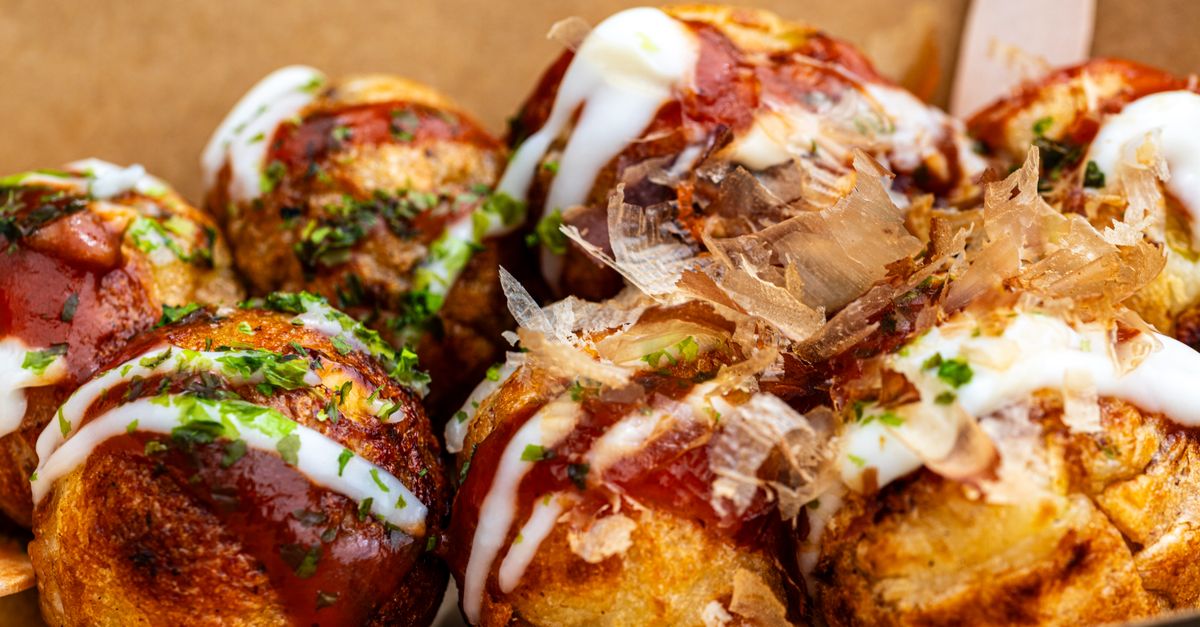
Takoyaki are balls of dashi-based batter filled with octopus, cooked in a moulded plate and generally served with sauce, mayonnaise, seaweed and dried bonito. This Osaka speciality is recognisable by its golden outer layer and tender, sometimes almost creamy centre. To appreciate them, you need to look beyond the toppings: the stock, batter texture and cooking are just as important as the piece of octopus.
Their history links older moulded snacks from the Kansai region with today’s street-food counters. From Aizuya’s sauce-free version to preparations covered with spring onion, tasting takoyaki reveals several interpretations of the same dish, with one essential precaution: let the heat escape before taking a bite.
In brief
Despite the French expression “octopus balls”, these are not made from chopped mollusc meat shaped into balls. The octopus is enclosed in a runny batter, which takes on its round shape during cooking. This distinction explains why the stock and the work done on the plate influence the result as much as the seafood filling.
The Japanese name, たこ焼き, combines “tako”, octopus, and “yaki”, referring to cooking with heat. The latter element also appears in other Japanese food names, including yakitori. Here, cooking takes place in rounded cavities rather than directly on a grill.
Flour provides structure, egg helps the batter hold together and dashi adds aromatic depth. This stock may contain seafood ingredients, but its role is not necessarily to give a pronounced fish flavour. Above all, it should make the batter tasty even before the condiments are added.
The piece of octopus provides a firm, slightly elastic bite. Around it, tenkasu, small pieces of fried tempura batter, add richness, while beni shoga, pickled red ginger, creates a sharp contrast. Spring onion adds a fresh, vegetal note that prevents the dish from feeling uniformly rich.
Proportions and seasonings vary between establishments. A heavily coated preparation highlights the sugar, acidity and creaminess of the sauces; a plain version immediately reveals the quality of the stock. Comparing these styles helps distinguish what comes from the batter and what comes from its finishing touches.
Takoyaki sauce adds a sweet-and-savoury flavour, while mayonnaise provides fat and a slight acidity. Aonori, finely ground green seaweed, strengthens the marine notes. Together, these form the most recognisable accompaniment, although they are not compulsory in every recipe.
Flakes of dried bonito, or katsuobushi, complete the dish with a smoky flavour. Very thin, they ripple when exposed to heat and air currents. This dramatic movement does not come from a live ingredient, but from dried topping placed on hot food.
| Element | Role when tasting | What to look for |
|---|---|---|
| Dashi batter | Soft texture and aromatic depth | A perceptible stock flavour beneath the toppings |
| Pre-cooked octopus | Contrast in texture | Pieces that are pleasant to chew, without excessive toughness |
| Sauce and mayonnaise | Sweet-and-savoury balance and creaminess | A coating that does not completely mask the batter |
| Aonori and katsuobushi | Marine and smoky notes | Complementary aromas rather than mere decoration |
A very crisp outer layer is not the only measure of success. Some shops aim for a thin, soft skin, while others prefer a more seared surface. The centre should remain tender without tasting of raw flour, but this taste-based judgement does not replace checking that it is properly cooked.
For comparison, taste one part with little topping, followed by a bite containing all the garnishes. You will identify the stock, ginger and contrast with the mollusc more clearly. A takoyaki’s personality begins in its batter, not in the amount of sauce.

The origins of takoyaki are usually associated with Tomekichi Endo, founder of the Aizuya chain in Osaka. However, the history claimed by this shop should be distinguished from the broader history of batter preparations cooked in moulds. The dish is part of a culinary evolution rather than a completely unprecedented break.
Japan’s Ministry of Agriculture, Forestry and Fisheries, or MAFF, links this speciality to older snacks, particularly choboyaki and rajioyaki. Their common feature is batter cooked on a plate with cavities. However, the shapes and fillings described are not identical in every historical account.
Rajioyaki is notably described as containing meat or konjac fillings. Adding octopus is a central part of the story popularised by Aizuya. This development shifted the balance of the dish: the seafood filling combined with stock-seasoned batter rather than a simple neutral shell.
Osaka Prefectural Central Library nevertheless notes differences between books devoted to these preparations. It also reports accounts mentioning octopus in some earlier snacks. Attributing the dish to Endo remains the most common version, but does not settle every detail of its lineage.
This distinction prevents several questions from being confused: who popularised the name, who established a commercial recipe and who first used this filling? A food tradition may preserve an emblematic founder even though its techniques and ingredients were already circulating among vendors.
In the story told by Aizuya, a customer reportedly mentioned Akashi’s octopus preparations, inspiring Endo. The city of Akashi also had exchanges with Osaka vendors, while acknowledging several theories about the origins. This connection is consistent with the visual and technical relationship between the specialities.
Akashiyaki are nevertheless clearly different at the table. Their batter contains more egg and they are traditionally dipped in warm dashi. The stock is therefore served directly as an accompaniment, whereas Osaka’s balls generally receive a coating or seasoning on the surface.
This difference also changes how they are eaten: one invites you to alternate between a bite and stock, while the other concentrates its flavours in the batter and toppings. Treating them as synonyms would erase what characterises each preparation. Their similarity reflects regional exchanges, not perfect identity.
According to the MAFF, thick sauce, aonori and fish flakes became established after the war. The style initially associated with Aizuya instead relied on batter already flavoured with dashi and soy sauce. Presenting the modern coating as indispensable from the beginning would therefore be misleading.
This evolution brings the speciality closer to okonomiyaki, another example of konamon, or flour-based dishes. It also explains why a plain version and a generously topped version can both represent Osaka. They simply highlight different stages and preferences.
Today the dish extends beyond the street counter: it is also prepared at home and appears among the foods served at Japanese matsuri. A home plate continues the same filling and turning movements. Comparing seasonings therefore lets you taste a history without reducing it to a fixed recipe.
To obtain the traditional shape, you need a plate with hemispherical cavities, either electric or suitable for your cooker. A flat frying pan can cook similar ingredients, but produces a different preparation. The sphere is created by gradually turning the batter in the cavities, not by shaping it by hand beforehand.
You will also need a container that makes pouring easy, a brush for distributing oil and a pick compatible with the coating. A metal tool can damage some non-stick surfaces. The manufacturer’s instructions therefore remain important, both for heating and for choosing utensils.
The usual base combines wheat flour, dashi and egg. Its consistency must allow you to fill the cavities and move the batter during turning; batter that is too thick is harder to work with. If you use a commercial mix, follow the proportions on the packaging, as seasoning and added ingredients vary by brand.
Use pre-cooked octopus cut into regular pieces, and prepare the spring onion, pickled ginger and tenkasu separately. This organisation means you do not have to chop fillings while the plate is heating. Pieces that are too large make it harder to close the spheres and produce a less even bite.
Choose the dashi as carefully as the condiments. A weakly flavoured base will produce a discreet batter that the sauce may overwhelm. Conversely, adding liquid at random to strengthen the flavour will upset the consistency: it is better to prepare the stock properly before mixing.
The right moment to turn depends on the appliance, how full the cavities are and the starting temperature of the ingredients. Copying a professional vendor’s exact rhythm therefore does not guarantee the same result. Instead, watch how the edges set and whether the shell can be released without tearing.
If the mixture sticks, check the greasing, heat and condition of the coating before forcing it with the pick. If it collapses, you may have started turning too soon. Waiting until the shell can support the movement gives you more control than making repeated, abrupt movements.
Rapid browning combined with an insufficiently heated centre indicates uneven cooking. A golden surface does not prove that the inside is ready: a food thermometer, used according to its instructions, provides a more reliable check. Follow official food-safety recommendations for foods containing flour and egg.
Finally, add the toppings after cooking rather than in the plate. This allows you to vary the amount on each portion and preserve part of the shell so you can judge its texture. Success depends more on suitable batter and gradual turning than on speed.
The main trap is inside: the centre may remain burning hot even when the surface seems manageable. Do not put a whole ball in your mouth as soon as it is served. Carefully open it with chopsticks or a pick, let the steam escape and wait before tasting.
Blowing only on the toppings does not necessarily cool the centre. The batter traps moisture beneath its shell, explaining the contrast between the outside and the first bite. The same precaution applies to reheated takoyaki, especially when some parts are hotter than others.
A tender, even creamy, interior is sought in many Osaka versions. You should therefore not always expect a dry crumb for the dish to be considered successful. However, this texture alone does not show that it has been heated sufficiently.
At home, safety depends on hygienic preparation and controlled cooking, not simply on how the food feels in your mouth. A raw-flour taste calls for correction, but its absence is not a food-safety test. Use your recipe’s instructions and official recommendations to check the centre.
For children, serve pieces that have been opened and sufficiently cooled, using suitable cutlery. A pick is a sharp object: do not leave it in the mouth or walk around with it between the lips. At a stall, use the eating area when one is available.
The traditional recipe generally contains wheat, egg and octopus. Dashi, mayonnaise, sauces and tempura fragments may add other problem ingredients, including fish, soy or shellfish. The exact composition must be checked product by product.
Removing visible bonito does not remove fish that may be present in the stock. Likewise, replacing the mollusc with cheese does not automatically make the preparation vegetarian. At a restaurant, ask what the batter and condiments contain, as well as whether they may come into contact with other foods on the plate.
A vegetarian adaptation may use kombu and shiitake stock, a vegetable filling and suitable sauces. For a vegan version, the egg must also be replaced and an appropriate mayonnaise chosen. These changes affect the texture: a formula specifically designed for this purpose will be more reliable than an improvised omission.
The same reasoning applies to gluten-free versions. Changing only the flour is not enough if the sauce, tenkasu or another component contains wheat. Preparation on shared equipment is also a separate issue from the ingredients, particularly in the case of an allergy.
Do not leave an overlooked tray at room temperature on the assumption that the speciality can also be eaten cold. Transfer leftovers to a shallow container and refrigerate them promptly under suitable conditions. Storage already changes the texture: moisture gradually softens the shell.
When reheating, make sure the centre is thoroughly hot. A small oven or air-fryer may help restore a firmer surface, while a microwave tends to retain more softness; the result depends on the appliance. Add fresh condiments afterwards: the pursuit of crispness must never replace checking that the centre has been heated.
Namba, Dotonbori and Umeda are practical starting points for discovering this speciality. The first group works well for a food-focused walk, while the area around Osaka Station is easy to include in a journey. The best choice mainly depends on your route and the seasoning you want to try.
To locate these neighbourhoods, see our Osaka guide. You do not need to cross the whole city to follow a ranking: comparing a plain preparation with a topped version at accessible establishments is often more informative. Here are shops with different approaches, without ranking their quality.
Aizuya is particularly interesting because of its connection with the dish’s history. Its style highlights batter flavoured with dashi and soy sauce, served without the usual coating. The Tamade shop is a useful reference point for anyone wishing to combine tasting with discovering the origins.
This simplicity makes the inner seasoning easier to appreciate. If you only know portions heavily covered with mayonnaise, the contrast will be clear, without meaning that the preparation is incomplete. It is precisely the absence of abundant toppings that makes the comparison useful.
Kogaryu in Amerikamura illustrates a more varied approach to finishing touches. Options include sauce with mayonnaise, soy sauce with mayonnaise, and spring onion with ponzu. The latter adds citrus notes that shift the balance towards greater freshness.
The right question is therefore not only “which shop should I choose?”, but also “which topping should I order?”. An acidic finish and a thick sauce highlight different aspects of the batter. Check the current options directly with the shop.
Wanaka is associated with Sennichimae, near Namba, and is an easy stop to include when exploring the neighbourhood. The chain also has a location in the Osaka Castle area. Choose the shop according to your sightseeing plans rather than making a special journey simply to visit another branch.
This approach works well for a street-food route in Osaka. Leaving room for other specialities helps you understand the area’s diversity, including the different uses of flour, sauces and stocks.
Hanadako, in the Shin Umeda Shokudo-gai arcade, is known for its negi-mayo version, generously covered with spring onion and mayonnaise. Its appeal lies in the contrast between the fresh vegetable element, rich topping and soft centre. Its location near Osaka Station makes it suitable for a stop in Umeda.
Takoriki, in the Karahori neighbourhood, takes a different approach by combining the speciality with a focus on wine. The establishment distinguishes its takoyaki offering from its evening restaurant service. Confirm the service available directly before making a special trip for the balls.
Opening hours, menus, payment methods and prices may change. When planning a visit in 2026, check this information with each establishment, particularly the relevant branch. On site, compare the actual portion sizes and any supplements: a price only has meaning when considered alongside the quantity and corresponding toppings.
Octopus is the traditional filling. Cheese, prawn and vegetable adaptations exist, but their batter may still contain fish dashi and egg. Check the full composition if you follow a particular diet.
The runny dashi-based batter creates a soft centre after cooking, while contact with the plate forms the outer shell. This softness is sought in many versions, but it does not by itself confirm that the centre has been properly cooked.
A moulded plate is needed to obtain the traditional round shape through successive turning. A flat frying pan can cook a preparation using similar ingredients, but its shape and texture will be different.
Takoyaki are associated with Osaka and generally served with toppings on the surface. Akashiyaki come from Akashi, have a batter richer in egg and are traditionally eaten dipped in warm dashi stock.
Carefully open the ball, let the steam escape and wait for the centre to cool before tasting. The surface temperature does not show how hot the inside is. Avoid putting a freshly cooked piece whole into your mouth.
Updated on 13/10/2026
Scroll to see more articles →