
Odaiba Tokyo: Things to Do on the Artificial Island
Discover Odaiba, Tokyo’s artificial island: attractions, beaches, museums and bay views for a memorable waterfront escape in the capital.
Okonomiyaki is a Japanese savoury pancake made with batter, finely shredded cabbage and toppings, cooked on a hot plate. Its name conveys the idea of grilling whatever you like. Behind this apparent freedom, the Osaka and Hiroshima versions use distinctly different techniques: the first mixes the cabbage into the batter, while the second assembles the ingredients in layers, usually with noodles.
The difference is clear on the plate. The Kansai style forms a thick, soft pancake; the Hiroshima style alternates a thin pancake, tender vegetables, meat, noodles and egg. Brown sauce, seaweed and other toppings complete the dish without masking the flavour of the cabbage or the cooking.
This everyday Japanese dish is eaten in restaurants, sometimes around a hot plate built into the table, and is also prepared at home. To discover it, it is better to understand the role of the ingredients than to look for one supposedly definitive topping: the structure distinguishes the styles, while the ingredients vary according to the restaurant and personal preferences.
In brief
Comparing it with a pancake helps explain the dish, but the comparison is imperfect. Okonomiyaki is not simply a wrapper filled after cooking: in the Osaka version, the vegetables contribute directly to its structure.
Cabbage provides volume, moisture and a sweetness that balances the condiments. Finely shredded, it softens while retaining a slight bite; if cut too coarsely, it makes assembling and turning the pancake more difficult.
The expression “Japanese cabbage” does not refer here to a compulsory ingredient. A round-headed cabbage with tender leaves works well for home cooking; Chinese cabbage, which is more watery and has a different texture, does not produce exactly the same result.
The base generally combines wheat flour, egg and dashi, a Japanese stock. The liquid hydrates the flour and adds flavour, while the egg helps the mixture hold together during cooking.
Grated nagaimo, a Japanese yam with a sticky texture, can make the mixture lighter and improve its softness. However, it is not included in every recipe: its absence does not prevent you from making a good pancake.
Tenkasu, small pieces of fried tempura batter, add texture and absorb some of the juices. Beni-shoga, red pickled ginger, introduces a sharp note that contrasts with the richness of the sauce.
Why avoid using too much batter? Because it can easily turn a preparation rich in vegetables into a floury mass: the binding should support the cabbage, not hide it.
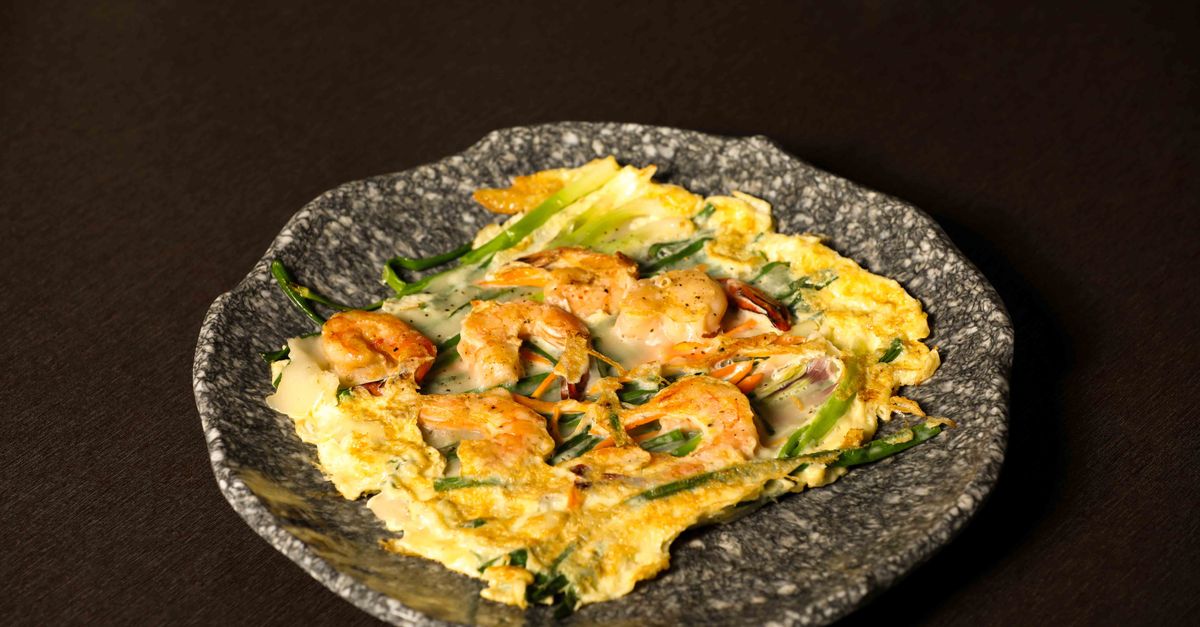
The essential difference concerns how the ingredients are assembled before and during cooking. Setting one version against another as more or less authentic does not do justice to these regional traditions: each has its own logic and variations.
In the Kansai style, the cabbage is combined with the batter and the ingredients intended to be incorporated. One detail matters: not everything is necessarily mixed in, since thin slices of pork are often placed on the surface before the pancake is turned.
This technique produces a relatively uniform texture, with pieces of vegetable distributed through every bite. Prawns, squid or cheese may be added, depending on the menu and personal taste.
The cook starts by spreading a thin pancake, then adds cabbage and the other toppings. The vegetables soften in the heat, while the noodles are cooked on the hot plate before being brought together with the rest and the egg.
Yakisoba is common, but some restaurants also offer udon. The appeal therefore lies not only in the volume: the layers create distinct textures, from tender vegetables to seared noodles and a thin base.
| Feature | Osaka style | Hiroshima style |
|---|---|---|
| Assembly | Cabbage incorporated into the batter | Ingredients layered |
| Base | Thick pancake | Thin pancake |
| Noodles | Depending on the variation | Usually included |
| Texture | Soft and bound together | Layered and contrasting |
| Home preparation | Suitable for a frying pan | More demanding in terms of space and handling |
Modan-yaki also combines a pancake and noodles, particularly in the Kansai region. Their presence is therefore not enough to identify a Hiroshima recipe: it is the construction of the dish that makes the difference.
Okonomiyaki sauce is thick, brown, sweet and tangy, with fruity and spicy notes. It resembles Worcestershire sauce, but its consistency and flavour balance are different: a direct substitution noticeably changes the result.
Japanese mayonnaise adds a creamy, tangy touch. Often drizzled over the top, it remains a variable finishing touch depending on the restaurant and style, rather than a universal requirement.
Aonori is a green seaweed ground into fine particles, with a marine aroma. Katsuobushi consists of flakes of dried bonito, generally smoked; their lightness explains the movement they make when they come into contact with the hot air above the dish.
These condiments do not serve the same purpose: the sauce coats, the mayonnaise softens and the dry toppings strengthen the aromas. It is better to start with a moderate layer and adjust it than to cover the surface immediately.
On a menu, buta-tama usually means a combination of pork and egg, while ebi-tama refers to prawns and egg. A seafood preparation may include several ingredients, so it is worth asking about its composition rather than making assumptions.
At home, cheese adds softness, but also salt and fat. Bacon gives a smoky note that differs from fresh pork: it is an adaptation, not a neutral replacement.
A meat-free version is not automatically vegetarian. Dashi may contain fish, as may some sauces, and bonito flakes must be removed for a vegetarian preparation.
If you have an allergy, also check for wheat, egg, soya and shellfish, depending on the recipe. Proper customisation starts with the actual ingredients, not just what appears on the pancake.
The Osaka style is the easiest place to start, because it does not require several separate layers to be moved around. A heavy-based frying pan, a lightly oiled surface and wide spatulas make cooking and turning easier.
Shred the cabbage, then separately mix the flour, cooled dashi and eggs until you have a smooth batter. Stir in the grated nagaimo if using, followed by the vegetables and chosen toppings.
The mixture should coat the cabbage and hold together when gathered, without becoming soupy. If the vegetables have just been washed, drain them carefully: excess water can make the mixture difficult to sear.
A browned surface does not guarantee that the inside is cooked. If the outside browns too quickly, lower the heat; a lid can help the heat reach the centre without burning the base.
Avoid pressing hard with the spatula: you would force out the moisture and compact the crumb. Making smaller discs that are easier to handle is better than risking breaking a large pancake when turning it.
Without nagaimo, the result can still be enjoyable, with a different texture. Baking powder does not reproduce its properties and is not an equivalent substitute: mastering the batter and heat matters more than an ingredient presented as indispensable.
Associated with Japanese street food, this dish is also enjoyed in specialist restaurants. A hot plate at the table does not necessarily mean that the customer cooks: it may simply keep the dish warm.
In some restaurants, the ingredients arrive in a bowl and the customer cooks the dish themselves. Elsewhere, staff prepare everything in front of the diners or bring an already-cooked pancake; ask how it works before pouring the mixture.
Teppan means the cooking plate. When an oil brush called aburahiki is provided, it is used to spread a thin film of fat; the spatulas are then used to turn and cut the pancake.
Follow the staff’s instructions concerning utensils and service. The hot plate remains extremely hot, even when the dish appears ready to eat.
During a stay in Osaka, a specialist restaurant lets you watch the mixed preparation and compare the toppings. In Hiroshima, Okonomimura brings together several establishments devoted to this speciality, but it is not a single restaurant or chain.
Menus, prices and opening hours can change: check them directly with the restaurants or the venue’s official manager. Also compare the included ingredients before adding extras.
In Tokyo, particularly in Tsukishima, monjayaki offers a different hot-plate cooking experience. It is a related but distinct speciality: its much more liquid batter creates a soft preparation that is scooped up with small spatulas, rather than a thick pancake cut into pieces.
The resemblance is mainly visual. Its batter, cabbage, stock and condiments give it a structure and flavour that differ from those of a buckwheat Breton galette.
No. A round-headed cabbage with tender leaves is suitable. Shred it finely and drain it after washing so that the mixture does not become too wet.
Yes, using vegetables, a vegetable stock and a sauce whose ingredients are suitable. Leave out the dried bonito and check that the dashi contains no fish.
They are characteristic of the common Hiroshima version, but not of the classic Osaka style. Some Kansai variations, such as modan-yaki, also contain them.
Updated on 12/10/2026
Scroll to see more articles →