
Odaiba Tokyo: Things to Do on the Artificial Island
Discover Odaiba, Tokyo’s artificial island: attractions, beaches, museums and bay views for a memorable waterfront escape in the capital.
A geisha is a professional artist specialising in traditional Japanese arts and hospitality. She performs at receptions, shows and gatherings centred on dance, singing, music and conversation. Her work does not involve offering sexual services: confusing geishas with courtesans is one of the most persistent misconceptions.
In Kyoto, these professionals are generally called geiko, while their apprentices are known as maiko. Behind their clothes lies demanding training, practices that differ from one district to another and an activity that is still alive today—one that cannot be reduced either to tourism or to a postcard image.
In brief
The term geisha combines the Japanese characters for art and person. This etymology describes a profession based on skills: performing a repertoire, accompanying a reception and adapting one’s performance to the guests. Appearance plays a part in the presentation, but it does not, by itself, constitute the profession.
At a traditional reception, often called ozashiki, the artists may perform a dance, sing or play the shamisen, a plucked string instrument. The programme depends on the professionals present, their specialities and the nature of the event. They therefore do not all perform exactly the same role during an evening.
Japanese dance relies in particular on precise postures, movements and use of the eyes. A fan can become an expressive prop, while a restrained movement conveys an emotion or accompanies a sung story. The quality of a performance is not measured only by how spectacular it appears.
Conversation is also part of the work. The artist must welcome guests, listen, introduce a subject, keep the conversation flowing and understand the group’s expectations. Reception games can add a light-hearted element without replacing the artistic skills at the heart of the profession.
This attention distinguishes a private evening from a stage performance. In a theatre, the audience watches a work organised for the stage; in a salon, the performers also adjust the pace of the gathering. Their expertise lies in bringing together performance, presence and hospitality.
The history of the profession is rooted in the entertainment districts of the Edo period. Male entertainers, notably known as taikomochi or hōkan, form part of this history. Women gradually took a central place in the profession, although this change cannot be reduced to a uniform replacement throughout the country.
These districts brought together various activities, some of which involved prostitution. This historical proximity explains some of the confusion, but it does not make the professions interchangeable. Artists and courtesans had different functions and professional codes.
Hanamachi, literally “flower districts”, became places of organisation and transmission. They bring together houses, reception establishments, teachers and professional networks. Their operation gives the profession a collective dimension that is often invisible to visitors.
Kyoto is particularly known for this heritage, but it does not have a monopoly on it. Traditions also exist in Tokyo and Kanazawa, another city associated with the culture of tea districts. Names, repertoires and career paths can vary from place to place.
It would nevertheless be reductive to present these professionals as the embodiment of all Japanese culture. They transmit one particular component of it, alongside other performing-arts and craft professions. They represent neither all Japanese women nor a universal model of femininity.
This activity supports relationships with musicians, dressers, hairdressers and textile artisans. A performance therefore depends on a whole group of complementary professions. Understanding a geisha starts with looking at what she can do, rather than interpreting her appearance.
Geisha training does not follow an identical model everywhere in Japan. The path often described to visitors corresponds mainly to Kyoto traditions. It is therefore necessary to distinguish the stages specific to certain districts from a rule that would automatically apply to every candidate.
An okiya, or geisha house, provides a professional base and, depending on the circumstances, a place of residence. It supports training, preparation and the relationships required for the work. It should not be confused with an ochaya, an establishment that hosts receptions.
In Kyoto’s traditional path, a beginner may go through a stage called shikomi. She learns the house’s customs, its daily demands and the foundations required for her future work. This period also helps her assess what this choice really involves.
Observation complements lessons. A stage known as minarai allows the apprentice to learn by watching experienced professionals in the context of receptions. Knowing when to intervene, how to bow or how to handle a prop requires a practical understanding of situations.
Guidance from an older colleague helps pass on this knowledge. Corrections concern more than choreography: they may involve posture, a polite expression or the way of entering a room. Professional behaviour is acquired through repetition, imitation and adjustment.
Dance, singing and traditional music play an important part in training. Instrumental practice requires memorising pieces, listening to the other performers and supporting a performance without unbalancing it. The student must gradually bring together technique, rhythm and expression.
Dance demands another kind of precision. Wearing a kimono changes the range of movement, while the use of space must remain consistent with the music and meaning of the piece. Repeating an apparently simple movement makes it possible to achieve a controlled rather than automatic performance.
The tea ceremony may also form part of artistic education, depending on the school and the individual path. Other cultural practices may complement this teaching, but it would be misleading to attribute a universal programme—including poetry, calligraphy and flower arranging—to every apprentice.
The status of maiko refers to an apprentice already involved in performance work. She continues learning while taking part in professional gatherings. It is therefore neither simply a costume nor a qualification obtained after a tourist workshop.
In Kyoto, the transition to geiko status is associated with the erikae, generally translated as “changing of the collar”. This stage marks a change in status and presentation. It does not mean that the artist no longer needs lessons or necessarily leaves a professional structure.
The length of the training and admission conditions depend on the houses and local traditions. A single recruitment age should not be presented as a national rule. For a genuine professional project, current conditions should be checked directly with the organisation concerned.
Daily life then combines rehearsals, clothing preparation, engagements and maintenance of the repertoire. The schedule varies according to performances and the artistic season: reducing it to morning lessons and nightly evenings would be artificial. A change of status recognises progress; it does not bring learning to an end.
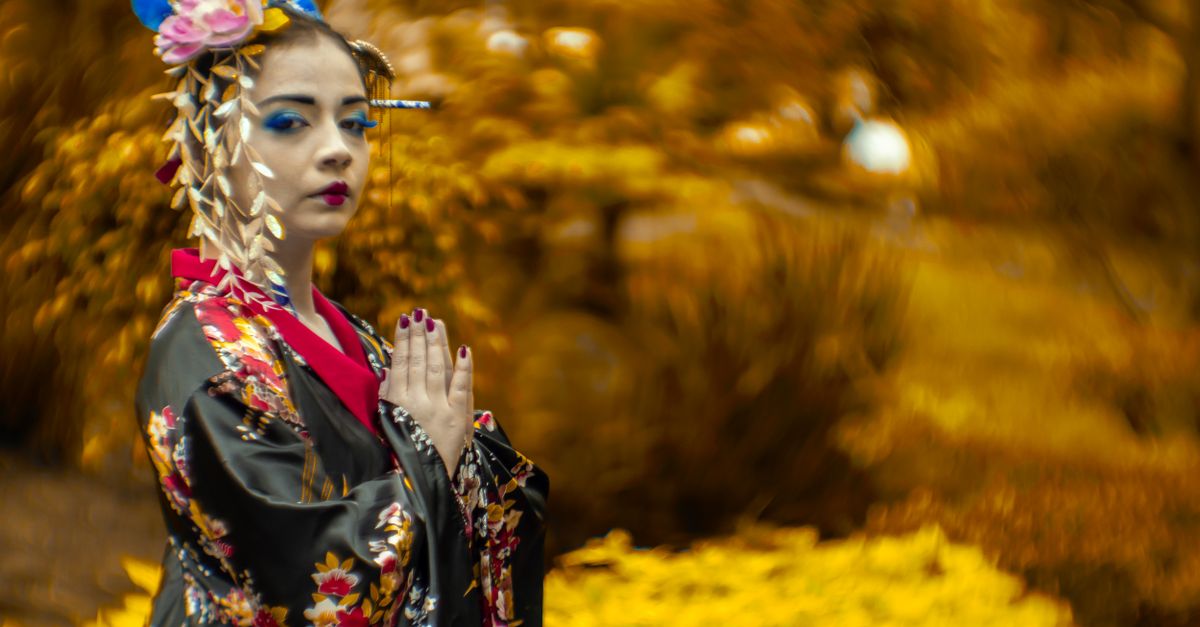
The kimono, hairstyle and make-up form a visual language linked to status, season and context. They can help explain certain customs, but cannot identify with certainty the profession of someone encountered in the street. Tourist dressing services make this caution especially useful in Kyoto.
In Kyoto traditions, an apprentice’s appearance is generally more ornate than that of an established artist. The sleeves, accessories and way of wearing the belt contribute to this distinction. Presentation also changes during training and does not depend solely on personal taste.
| Element | Maiko in Kyoto | Geiko in Kyoto |
|---|---|---|
| Status | Apprentice in training and professional activity | Established artist continuing her practice |
| Kimono | Generally more colourful and ornate presentation | Often a more understated composition |
| Obi | Characteristic long, trailing belt | Generally more compact knot |
| Hairstyle | Natural hair traditionally styled according to the stage of training | Traditional wig frequently worn for formal engagements |
| Footwear | Characteristic okobo, depending on the occasion | Other sandals suited to the clothing and context |
These points describe local tendencies, not a system valid in every region. Stage clothing, a ceremony or an ordinary journey may alter the usual presentation. Professional clothing should also be distinguished from costumes intended for a photo session.
The obi, the wide belt of the kimono, contributes to the silhouette and balance of the outfit. Tying it requires specific expertise. Among Kyoto apprentices, its trailing length is particularly recognisable, but it forms part of a complete outfit rather than being an isolated detail.
Plant motifs, colours and ornaments may evoke the season or a particular occasion. This relationship with the calendar explains why the wardrobe is not simply a decorative choice. The consistency between the different pieces matters as much as their visual richness.
Okobo, raised wooden sandals, are mainly associated with maiko. Presenting them as the standard footwear of every geisha would be inaccurate. Footwear varies according to status, circumstances and local customs.
Hair accessories, particularly kanzashi, provide further clues. Their arrangement may change throughout the training and with the seasons. For visitors, they offer another way of reading the outfit, but cannot by themselves reveal the wearer’s identity or precise level of experience.
White make-up, called oshiroi, forms part of certain professional and stage presentations. It does not mean that the artists wear it in every situation in their lives. How often it is used depends in particular on the context and type of engagement.
The painted face, touches of colour and hairstyle create a codified appearance. Avoid turning every detail into a mysterious symbol or sign of seduction. Explanations vary according to custom, and an isolated interpretation can be misleading.
This preparation also requires practical coordination: dressing, maintaining fabrics and caring for accessories accompany the artistic work. The clothing serves a performance and imposes its own movement restrictions. It is therefore not separate from the physical technique studied during lessons.
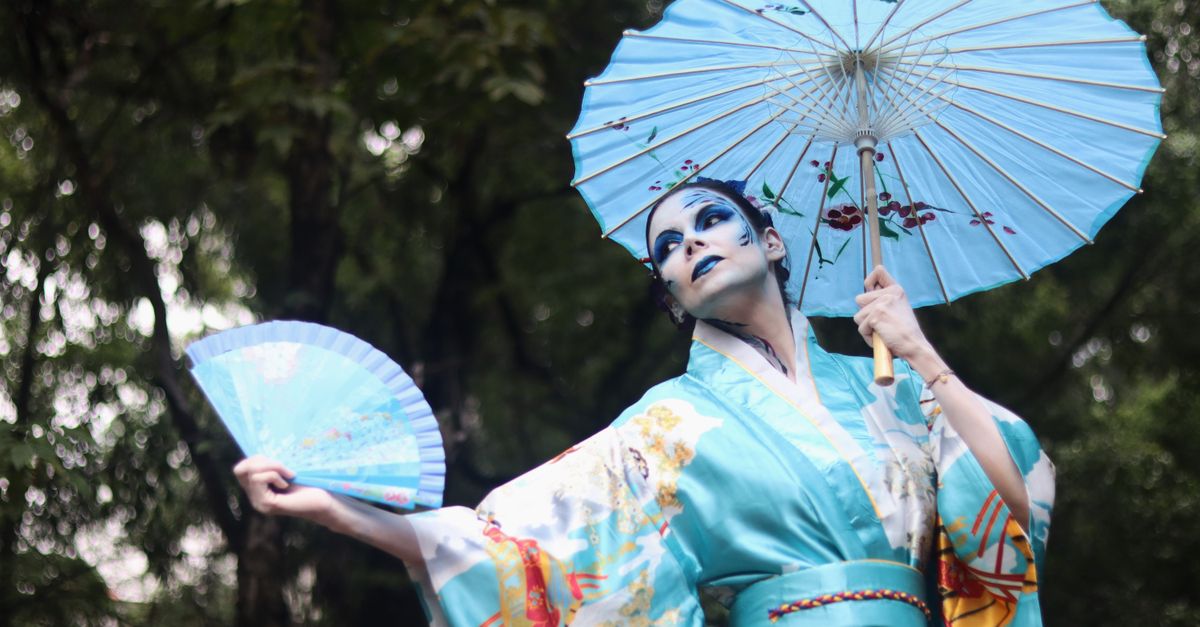
A visitor can hire a kimono or book an aesthetic transformation without belonging to the profession. Conversely, an artist in ordinary clothes does not lose her status. Costume makes certain codes visible; only professional practice defines the occupation.
Misconceptions often come from a mixture of the history of pleasure districts, romanticised representations and tourist images. Correcting them requires distinguishing professions, periods and situations. A work of fiction may borrow real elements without providing a reliable description of how the profession operates today.
A geisha is not a courtesan. The professional service she offers involves artistic performance and hospitality. Conversation, elegance or rapport at a reception do not turn it into a sexual service.
Oiran belong to the history of high-ranking courtesans. Their clothing and certain artistic skills can create visual comparisons, but their historical functions were different. Using these terms interchangeably erases precisely the distinctions needed for understanding.
This distinction should not lead to an idealised view of the past. Economic conditions, relationships of dependence and women’s place in society have changed. Recognising these historical realities does not, however, justify automatically attributing the same practices to every professional today.
Stories about patronage are also often misunderstood. Historical financial support is not enough to define the profession or describe the personal circumstances of a contemporary artist. General claims that every geisha is kept by a patron should be avoided.
Discretion is linked in particular to the confidentiality of receptions and relationships of trust with establishments. It does not mean that all activities are hidden. Shows and some organised meetings allow the public to discover the repertoire in an announced setting.
Access conditions nevertheless differ according to the houses and events. A private reception may operate by recommendation, while a public performance follows its ticketing arrangements. There is no single rule allowing anyone to claim that every meeting requires a personal invitation.
The profession does not consist of waiting for visitors in historic districts either. Someone seen in an alley may be travelling to an engagement and have little time available. Her journey is not a public attraction.
The continuity of traditional arts does not prevent the activity from being contemporary. Some organisations use digital tools to present their work or communicate with the public. This visibility does not mean that every house has adopted the same practices.
Conversely, keeping an old garment or inherited repertoire does not mean living outside modern society. Artists organise their careers, maintain professional relationships and respond to the expectations of different audiences. Their tradition rests on people at work, not on a permanent reconstruction.
Systematically describing them as mysterious, submissive or timeless reduces their work to an outside fantasy. These adjectives reveal little about their interpretive choices, musical memory or ability to conduct a reception. A precise description of their skills is more informative than an accumulation of symbols.
Finally, visible elegance should not hide the physical and repetitive side of the work: maintaining a posture, rehearsing a piece and preparing an engagement require consistency. Respecting these professionals means recognising their skills and limitations rather than assigning them an imagined role.
To understand their art, choose a performance rather than improvised observation in the street. A show allows you to appreciate the dance and musical accompaniment; an organised meeting may also explain the customs. The best format depends on what you want to discover, not only on whether you can take a photograph.
A stage performance gives access to a programme designed for an audience. It is particularly suitable for travellers who want to hear a repertoire and watch choreography without taking part in a private evening. The layout of the venue and photography arrangements depend on the organiser.
A reception offers a different relationship, with more interaction and sometimes traditional games. Before booking, ask what is included: artistic performance, any meal, interpreting and audience participation. These details help you compare experiences that may have similar names.
Also check whether the announcement concerns professionals, apprentices or a costumed activity. All of these options may suit different expectations, but they are not equivalent. Our guide to activities involving geishas in Kyoto helps clarify what you are looking for.
Prices, availability and cancellation conditions change. Check them directly with the official ticket office, establishment or responsible organisation before making any payment. Also confirm the language of the explanations and the access conditions.
Gion remains an inhabited neighbourhood and a place of professional activity. Its streets are not a backdrop where passers-by are expected to pose. To plan a walk focused on heritage, consult our guide to Kyoto and its neighbourhoods.
Do not follow an artist, block her path or touch her kimono or accessories. Give up on taking a photograph if doing so would require you to approach without permission or delay her journey. A visitor’s discretion matters more than a souvenir obtained at any cost.
Restrictions on movement and photography may differ from one street to another, particularly in private passages. Follow the signs and check current instructions with the municipality or relevant local organisation. It would be misleading to present a temporary instruction as a uniform ban throughout Kyoto.
Attending a tea ceremony is another way to discover precision of movement, attention to objects and the customs of hospitality. This practice nevertheless has its own schools and specialists: it is not reserved for geiko. A tea ceremony experience in Kyoto can therefore complement a cultural discovery without being confused with a professional meeting.
During an organised discussion, questions about the repertoire, instruments or training are especially relevant. Asking how a dance is practised opens a conversation about the profession. Intrusive questions about private life or personal relationships, on the other hand, take attention away from the purpose of the meeting.
Ask permission before taking photographs or filming, and respect the stated conditions. Permission for one image does not necessarily authorise recording an entire performance. A successful visit leaves room for listening, observation and the artists’ own pace.
Geisha refers to a professional of the arts and hospitality. Geiko is the name generally used in Kyoto for an established artist. Maiko refers to an apprentice in the local tradition; this path does not apply uniformly in every region.
No: their professional performance is based on dance, music, singing, games and conversation. Historical proximity to pleasure districts should not lead people to confuse them with courtesans.
Yes, public shows and some organised meetings allow visitors to discover these arts. Conditions vary according to the establishment and event, so check the current arrangements with the official organiser.
Do not assume that her presence gives permission to take a photograph. Respect signs, private spaces and the person’s consent, without following her or obstructing her path. Local instructions should be checked with the relevant organisation.
No. An aesthetic transformation allows you to wear traditional clothing for a tourist or photography experience. The profession requires artistic training and professional practice that clothing cannot replace.
Updated on 22/10/2026
Scroll to see more articles →