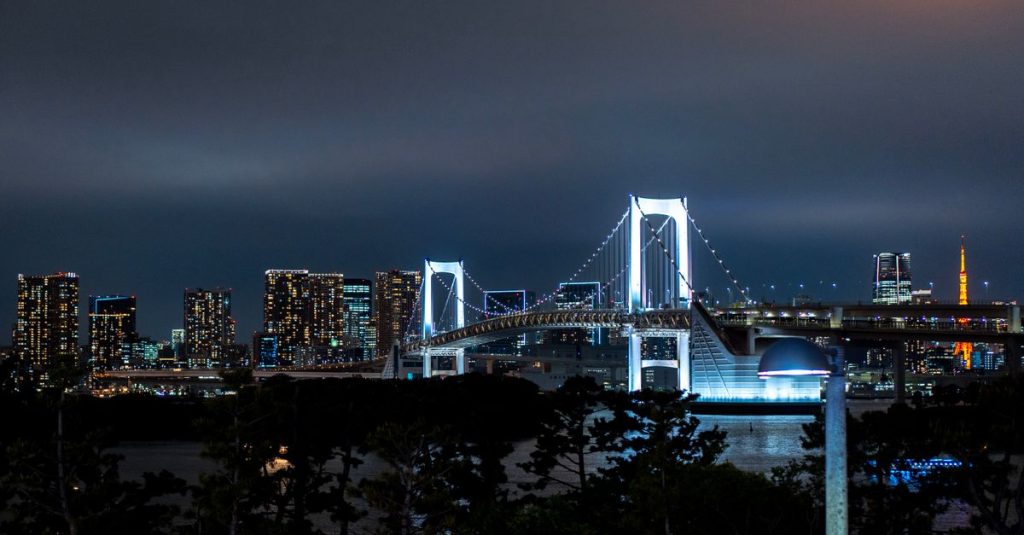
Odaiba Tokyo: Things to Do on the Artificial Island
Discover Odaiba, Tokyo’s artificial island: attractions, beaches, museums and bay views for a memorable waterfront escape in the capital.
Japan has a single time zone: Japan Standard Time, or JST, at UTC+9, with no summer or winter time change. It is therefore 7 hours ahead of metropolitan France during French daylight saving time and 8 hours ahead during French winter time. Tokyo, Osaka, Kyoto, Sapporo and Okinawa all show exactly the same time.
To find the Japanese time at the moment you are reading this, add the difference to the French time, checking whether you move into the following day. For a trip, call or meeting, the key point is the date of the appointment: Japan remains on the same time all year, while several French-speaking countries change their seasonal time regime.
JST stands for Japan Standard Time. The National Institute of Information and Communications Technology, or NICT, is the Japanese organisation responsible for producing and disseminating this time reference, set at UTC+9. This reference applies throughout Japan in 2026.
You therefore do not need to make any adjustment when travelling from Tokyo to Kyoto and then Osaka. The same rule applies to Sapporo, on the island of Hokkaido, Hiroshima and Naha, in Okinawa: travelling within Japan does not change the legal time.
A common clock does not mean that the sun rises everywhere at the same time. Longitude, latitude and the season affect the length of the day and sunrise and sunset times.
When planning an outdoor visit, distinguish between the official time and the expected daylight. The astronomical forecasts of the National Astronomical Observatory of Japan let you check data for a city on a specific date; our guide to the best season to travel to Japan helps put this question into the wider context of your trip.
On a phone, add Tokyo to the world clock. This city is a valid reference for the whole country, even if your final destination is elsewhere in the archipelago.
On arrival, check the automatic time-zone setting and the displayed date. An eSIM is not essential for setting the time: you can select Tokyo manually if the device has not updated itself.
Japan is ahead of the French-speaking countries presented here. From Europe, add the difference to obtain the Japanese time; from Japan, subtract it to find the time of the person you are contacting.
For the 2026 reference points, the relevant authorities are Service-Public.fr in France, the Royal Observatory of Belgium, the Federal Office of Metrology METAS in Switzerland and the National Research Council of Canada. Their legal-time rules, combined with the NICT reference, produce the conversions below.
Paris, Brussels and Geneva follow the same time regime: UTC+2 during daylight saving time and UTC+1 during winter time. Japan is therefore 7 or 8 hours ahead of these cities respectively.
The terms “summer” and “winter” here refer to the time regime of the country of departure, not the weather in Japan. This distinction matters particularly for a spring or autumn trip, when a European time change may take place during the journey.
| City of departure | Local time | In Japan during departure-country daylight saving time | In Japan during departure-country winter time |
|---|---|---|---|
| Paris, Brussels or Geneva | 9 am | 4 pm | 5 pm |
| Paris, Brussels or Geneva | 12 pm | 7 pm | 8 pm |
| Paris, Brussels or Geneva | 10 pm | 5 am the following day | 6 am the following day |
| Montreal or Quebec City | 8 pm | 9 am the following day | 10 am the following day |
For Montreal and Quebec City, Japan is 13 hours ahead during Eastern Daylight Time and 14 hours ahead during Eastern Standard Time. These figures should not be applied without checking to every location in Quebec, as some follow specific arrangements.
Canadian and European seasonal changes do not necessarily take place on the same dates. For a meeting between Paris, Montreal and Tokyo, use a calendar configured with each city rather than a conversion based only on the French season.
The wording “the following day” is part of the conversion: a correct time attached to the wrong day is enough to make you miss an appointment.
Japan currently keeps a permanent standard time. Daylight saving time is not a geographical requirement: it is a national organisational choice that changes the displayed time to shift activities in relation to natural light.
Moving clocks forward does not create extra sunlight. It only changes the relationship between civil time and the cycle of the day, with different effects depending on regions, occupations and lifestyles.
Japan applied a seasonal time change for a short period after the Second World War, during the Allied occupation. The historical archives of the National Diet Library document this experiment, which was later abandoned.
It would therefore be inaccurate to say that Japan has never had daylight saving time. However, current conversions do not require any Japanese changeover calendar: only the regulations of the country being compared with Japan can alter the difference.
A fixed regime avoids seasonal adjustments to calendars, equipment and recurring appointments within the country. Reintroducing daylight saving time would require coordination between government departments, businesses, transport operators and computer systems.
This stability does not, by itself, prove that one regime is universally better than the other. For travellers, the consequence is simpler: Japanese clocks do not move when France changes its clocks.
From France, choose the morning to reach a Japanese contact during their afternoon. This is generally a better compromise than calling after your lunch, when it is already evening in Japan.
The following conversions follow the legal-time rules of the NICT and Service-Public.fr for 2026. They are planning guides, not the opening hours of a business or institution.
An appointment that is acceptable in summer can therefore become late after France returns to winter time. Ask about your contact’s actual availability, especially for a long meeting or a call to an administrative service.
Create invitations using a geographical time zone, such as Paris or Tokyo, rather than entering a difference manually. For a recurring meeting, decide which team keeps a fixed time: the other team will see its local slot change when Europe switches time.
Also specify the Japanese date and time in the accompanying message. Public holidays do not necessarily coincide, and a Friday evening in Europe may already be Saturday in Japan.
For asynchronous work, send a complete file with the documents, the decision required and an explicitly localised deadline. A clear request prevents losing an entire day in a simple exchange of clarifications.
Jet lag is the difference between your body clock and the local time. It can disrupt sleep, alertness, appetite or digestion; travel fatigue can add to it without having exactly the same cause.
Adjustment varies from person to person, according to sleep before departure and travel conditions. The CDC recommendations in its traveller health guide, the Yellow Book 2026, notably favour managing sleep and light exposure rather than promising a guaranteed recovery time.
If your schedule allows, gradually move your bedtimes and waking times closer to those of your destination. During the flight, use Japanese time as a reference for planning rest, without forcing yourself to sleep at all costs.
On arrival, plan a flexible schedule: dropping off your luggage, eating and then taking a gentle walk is often more sensible than a packed day. You can postpone demanding visits to Hiroshima or long domestic journeys until after some initial recovery.
Light helps regulate your body clock, but the timing of exposure matters. If you have significant symptoms, travel frequently or have a chronic illness, seek personalised medical advice rather than following an identical light-exposure programme to everyone else.
Avoid relying on alcohol to fall asleep and limit caffeine as local bedtime approaches. If you need to rest during the day, take care not to turn a nap into a long sleep that delays the following night.
Melatonin and sleeping tablets should not be taken automatically. Ask a healthcare professional for advice and check the import conditions for your medication with the Japanese Ministry of Health; medical formalities are separate from those for a Japanese visa.
On your return, gradually resume French routines and leave some leeway before an activity requiring a high level of alertness. For exact departure and arrival times, check with your airline and prepare the logistics using our guides to flights to Japan and Japanese transport.
Add 7 hours to the time in metropolitan France during French daylight saving time, or 8 hours during French winter time. Check whether this moves you into the following day. Your phone’s world clock, set to Tokyo, lets you check the current time without calculating it manually.
It is 7 pm in Japan during French daylight saving time and 8 pm during French winter time. These conversions correspond to the time regimes published by the NICT and Service-Public.fr, applicable in 2026. They apply to metropolitan France, not to all overseas territories.
Yes. All of Japan uses Japan Standard Time, or JST. You do not change time zones during a domestic journey, even between Hokkaido and Okinawa. However, daylight varies according to the region and season.
No. Montreal follows Canadian seasonal changes, not those of France. Japan remains on a fixed time. For an appointment involving several countries, enter the cities in a calendar and check the conversion for the planned date.
Tickets generally show departure in the local time of the departure airport and arrival in the local time of the arrival airport. Do not automatically add the time difference to the displayed arrival time. Above all, check the date and the airline’s information, as well as any flight changes.
Updated on 06/10/2026
Scroll to see more articles →