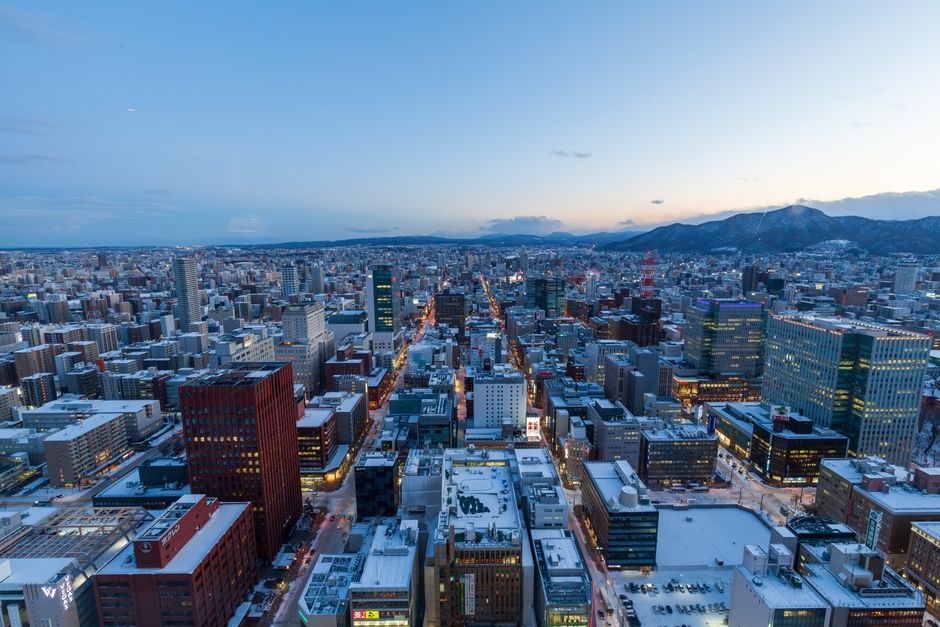

Why stay near Sapporo Station
Sapporo Station is Hokkaido’s central transport hub:
- Excellent connections – JR Hakodate, Chitose (to New Airport) and Sassho lines.
- Underground (subterranean) – Paseo, Aurora Town, Diamond Street.
- Snow Festival (February) – Odori Park 5 minutes away; outdoor Snow Festival.
- Historic sightseeing – Sapporo TV Tower (147 m), Tokeidai.
- Restaurants – Susukino (5 minutes): miso ramen, Genghis Khan (lamb).
See also Sapporo.
Best hotels near Sapporo Station
A few properties:
- Sapporo Grand Hotel (Kita 1-jo Nishi 4) – Hokkaido’s first historic hotel (1934), 360 rooms. From 18,000 yen.
- JR Tower Hotel Nikko Sapporo – Integrated into JR Tower, 350 rooms. From 22,000 yen.
- Sapporo Prince Hotel (Minami 2) – 587 rooms, 5 minutes from the station. From 16,000 yen.
- Keio Plaza Hotel Sapporo – Business hotel with 460 rooms. From 18,000 yen.
Compare actual prices on Booking Sapporo.
Onsen and ski resorts
Sapporo is the ideal base for skiing:
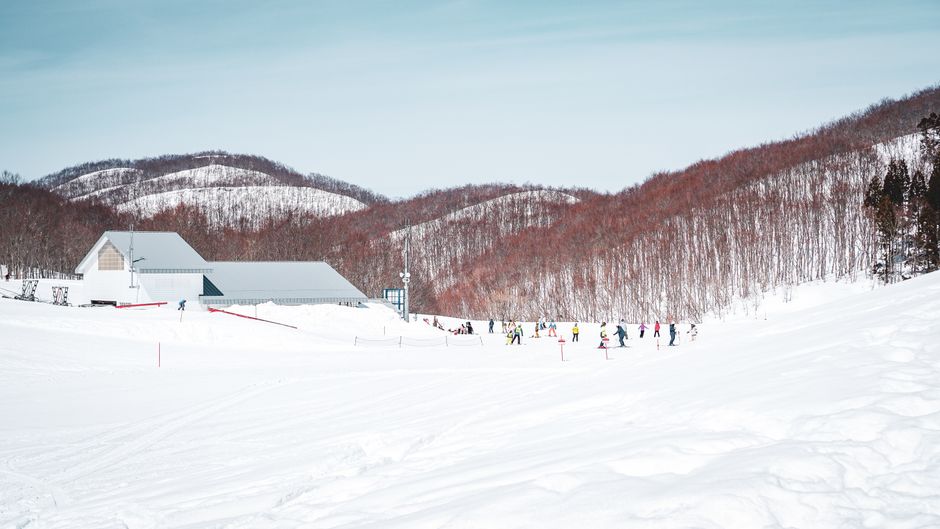
- Sapporo Teine Ski Resort – 30 minutes by car.
- Kiroro – Skiing available until May, 90 minutes away.
- Niseko – The world’s best powder snow, 2 hours by car.
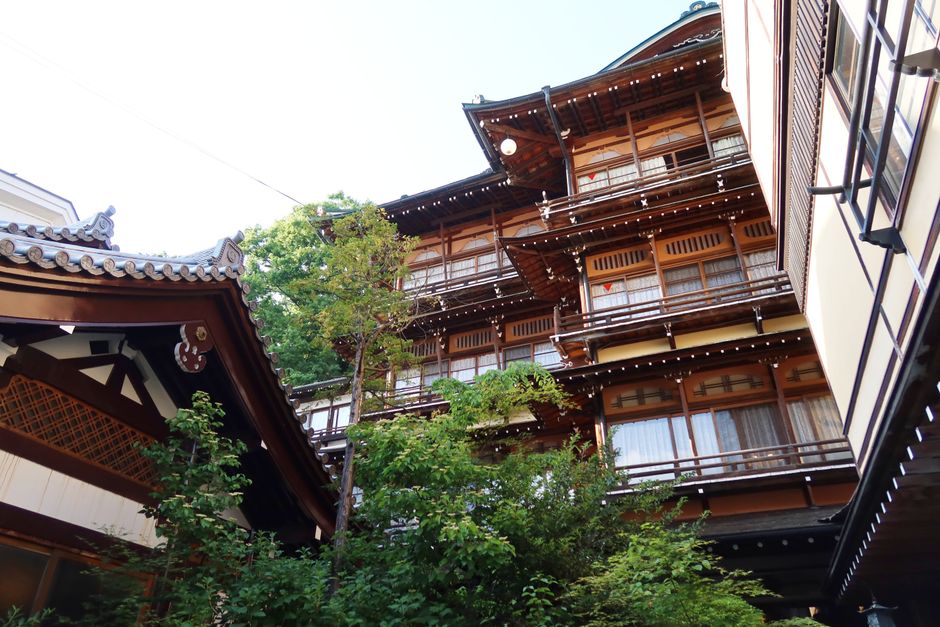
- Hoheikan Onsen – Traditional onsen dating from 1880.
Hotels by budget
Sapporo offers good value for money:
- budget (5,000–9,000 yen / 30–55 EUR) – Capsule hotels, hostels.
- mid-range (10,000–18,000 yen / 60–115 EUR) – APA Hotel Sapporo, Dormy Inn, Toyoko Inn.
- upmarket (18,000–30,000 yen / 115–190 EUR) – JR Tower Hotel Nikko, Sapporo Prince.
- luxury (35,000+ yen / 220+ EUR) – Sapporo Grand, ANA Crowne Plaza, Hoshinoya Tomamu.
How to get to Sapporo Station
Sapporo can be reached by plane or Shinkansen:
- New Chitose Airport (CTS) – JR Rapid Airport (37 minutes, 1,150 yen).
- From Tokyo – Hayabusa Shinkansen (7h50) or plane (1h30).
- From Hakodate – Hokuto Shinkansen (3h45).
For flights to Sapporo: Skyscanner Sapporo.
Restaurants in Sapporo
Sapporo specialities:
- Ramen Yokocho (Sapporo Ramen Kyowakoku) – 16 ramen stalls.
- Susukino – Nightlife district, izakayas and Genghis Khan.
- Sapporo Beer Museum – Historic brewery dating from 1876.
- Nijo Market – Seafood and uni market.
Book at the best price in Sapporo
Tips:
- Snow Festival (5–12 February) – Hotels are fully booked 3 months in advance.
- Summer season – July–August, lower prices.
- JR Pass – Covers the train to Sapporo from Tokyo.
Compare actual prices on Booking Sapporo.
Also worth discovering
Continue exploring Japan with our complementary guides.


Where to stay in Sapporo: Odori for sightseeing, the station for trains, Susukino for evenings
Choose Odori for a well-balanced first stay, Sapporo Station for frequent train departures and Susukino for an easy walk home after dinner. Nakajima Koen is better suited to those who prioritise peace and quiet, while Maruyama appeals to travellers looking for a residential atmosphere and green spaces.
The right location depends less on its central position on the map than on the journeys you make each day. Reaching a platform with luggage, returning from a restaurant late at night or walking along a snow-covered pavement all present different challenges.
| Neighbourhood | Atmosphere | Who is it for? | Access and trade-offs |
|---|---|---|---|
| Sapporo Station | Commercial, convenient and transport-focused | Short stays, travellers with heavy luggage and railway excursions | JR trains, connections to New Chitose, the Namboku and Toho metro lines; Susukino restaurants are further away |
| Odori | Central and urban, brought to life by events in the park | First-time visitors and itineraries combining walks, the metro and restaurants | Interchange between the three metro lines; underground access to the station and Susukino |
| Susukino | Restaurants, illuminated signs and nightlife | Travellers who regularly go out in the evening | Namboku Line, tram and arcade leading to Odori; noise levels should be checked |
| Nakajima Koen | More peaceful around the park, depending on the street | Families, those seeking peace and quieter stays | Namboku Line; an additional journey to reach regional trains |
| Maruyama | Residential, with cafés and green spaces | Travellers who prioritise local neighbourhood life and visits to the west | Tozai Line at Maruyama Koen; a change is needed to reach the station |
Odori: the best compromise for discovering Sapporo
Odori is the most versatile choice when your itinerary does not favour any particular direction. The Namboku, Tozai and Toho lines meet there, making it easier to visit different areas without always returning to the same point.
The park, television tower and shopping streets make it easy to alternate between walks and urban sightseeing. The restaurants to the south remain accessible, while the station can be reached via the city-centre underground walkways.
However, bear in mind the size of the park: accommodation near its western end does not offer the same access to connections as a property close to Odori Station. Check which station is actually nearby, rather than relying solely on the phrase “near the park”.
Susukino: stay near the restaurants rather than the platforms
Susukino becomes particularly appealing when several evenings end in its restaurants and bars. Its proximity to the Tanukikoji shopping arcade also makes it possible to shop without arranging a specific trip from the northern part of the city centre.
The atmosphere varies considerably between the main roads and the side streets. Check recent reviews concerning room soundproofing, room orientation and night-time disturbance, rather than assuming that the whole area is uniformly noisy.
An occasional night out is not enough to make this the obvious choice. On the other hand, walking back after several late dinners may be more comfortable than having slightly easier access to the airport train.
Nakajima Koen and Maruyama: prioritising the setting for your stay
Nakajima Koen is suitable if the peace and quiet you seek, or the features of the accommodation, outweigh its more southerly location. The park offers pleasant surroundings for walks, but not all the nearby streets are equally quiet.
Maruyama caters to a different priority: staying in a residential neighbourhood close to the park, Hokkaido-jingu Shrine and the zoo. Its access to the Tozai Line makes journeys to Odori easy, but it does not offer the same flexibility for early-morning JR departures.
Accommodation is less concentrated here than along the central corridor. Your choice should therefore be based on a specific address, the useful shops nearby and the route to the metro, especially if you are considering an apartment.
The best neighbourhood removes a daily inconvenience, not just a problem encountered on arrival.
Tip: set up a Japan eSIM before departure so your data works on arrival.
Staying near Sapporo Station: access from New Chitose and train departures
Sapporo Station is the most convenient base if you are taking several JR journeys or carrying bulky luggage. It makes arriving from the airport easier, but its main advantage becomes apparent when you also use the railway during your stay.
The area brings together shops, restaurants and useful services around a major transport hub. It is particularly suitable for short stays, when an extra connection may be more of a burden than being close to nightlife.
Getting to Sapporo from New Chitose Airport
The JR train connects New Chitose directly with Sapporo, generally taking around forty minutes depending on the service. The airport station is beneath the domestic terminal; from the international terminal, you need to allow extra time to walk indoors to this area.
Follow the railway signs and check the next departure on the screens. Not all services have the same stops or journey time: check the timetable applicable to your journey on the JR Hokkaido official website.
Some trains have reserved seats in a dedicated carriage. If you would like this option, check the conditions when purchasing your ticket, particularly during busy periods.
For a late arrival, check the last departure compatible with your flight. Disembarkation, formalities and baggage collection all take time: your landing time is not the time at which you will be on the platform.
Choosing the right side of Sapporo Station
Prioritise the actual route between reception and the platforms rather than straight-line distance. The north and south exits lead to different streets, and crossing a large railway complex can sometimes add a walk that is not obvious on a map.
The south side generally makes it easier to get to Odori and the central underground walkways. To the north, the benefits depend more on the building’s exact location and the visits planned, particularly around Hokkaido University.
Phrases such as “in front of the station” or “near the station” guarantee neither covered access nor a lift along the shortest route. To compare accommodation in the area, the selection devoted to properties around Sapporo Station should be supplemented by checking the access information provided by each establishment.
Sapporo metro station and JR station belong to the same major transport hub, but their platforms are separate. The Tozai Line does not serve this area directly: the three municipal lines connect at Odori.
When being close to the trains really makes your stay more comfortable
Several train departures add more value to the area than a simple airport transfer. Otaru, continuing on to another city in Hokkaido or an early-morning departure are practical reasons to stay near the platforms.
Conversely, if you spend most of your days in the city and your evenings to the south, you may not make much use of the railway connections. Compare the whole stay, not just your first journey.
For a very early flight, staying near Sapporo Station does not automatically solve the transport question. Check that the first train allows you to arrive at the airport by the recommended time; if not, consider spending your final night closer to the terminal.
Finally, Sapporo is not served by the Shinkansen in 2026. Train journeys from this station rely on conventional lines, so do not plan your itinerary assuming a high-speed connection is available there.
Which accommodation should you choose in Sapporo: a business hotel, onsen or apartment?
Choose a business hotel for simplicity, an establishment with an onsen for hot-spring baths, and an apartment for greater independence. The area alone does not guarantee a comfortable stay: the room, facilities and hosting arrangements matter just as much.
Two neighbouring properties can meet very different needs. A staffed reception, laundry facilities or enough space to open several suitcases may be more useful than a service you will never use.
Business hotels in Sapporo: practical for short stays
A business hotel suits travellers looking for a straightforward arrangement who spend most of the day out and about. Rooms are often compact, with a private bathroom and functional facilities, but their layout varies depending on the category booked.
Check the advertised floor area, bed dimensions and bed layout. A room offered for two people does not necessarily provide enough space to open two large suitcases at the same time.
Laundry facilities become useful after several days of travelling, while luggage storage makes it easier to arrive before the room is available. These services are not always provided: check the conditions, particularly for luggage kept after departure.
Breakfast also deserves a practical check. If it starts after the time you need to leave for an excursion, its inclusion offers no advantage on those days.
Hotel with an onsen: check the type of bath and its rules
A large communal bath is not automatically an onsen. The term refers to water that meets specific criteria relating to its source and composition or temperature; a heated pool can be enjoyable without being a hot spring.
Read the official description to distinguish between a public bath, hot-spring water and any private bath. Also check the opening hours, as a late arrival or very early departure may prevent you from using it.
Communal baths are usually used without swimwear, after washing thoroughly. Rules concerning tattoos, children and access to the different areas vary: contact the establishment if any of these points affects your booking.
For a genuine hot-spring stay, a night in a destination such as Noboribetsu may be more suitable than a simple urban facility. In Sapporo, the bath is mainly a comfortable extra after sightseeing or a day in the cold.
Apartments in Sapporo: more independence, but variable services
An apartment is useful for cooking, washing clothes and having separate spaces during a longer stay. It can suit families, provided you check the number of proper beds and the layout rather than relying solely on the stated maximum capacity.
A kitchenette does not necessarily include all the utensils needed to prepare full meals. Likewise, having a washing machine does not mean that a tumble dryer or a practical drying area is available.
You may check in without a reception desk, using instructions sent in advance. Make sure you have the access information before travelling and check the assistance arrangements in case of a problem.
- With children: check the bedding, occupancy conditions and lift access.
- In winter: look for suitable heating and an entrance where you can manage wet shoes and snow-covered clothing.
- For several nights: compare laundry facilities, kitchen facilities, housekeeping and nearby food shops.
- For the final amount: check mandatory fees, included meals and cancellation conditions.
Reading the rules on tourist taxes in Japan in 2026 can supplement this check, but does not replace the information applicable to your booking. Always compare equivalent services and the stated total, not just the first price displayed.
Staying in Sapporo in winter: underground walkways, snow and busy periods
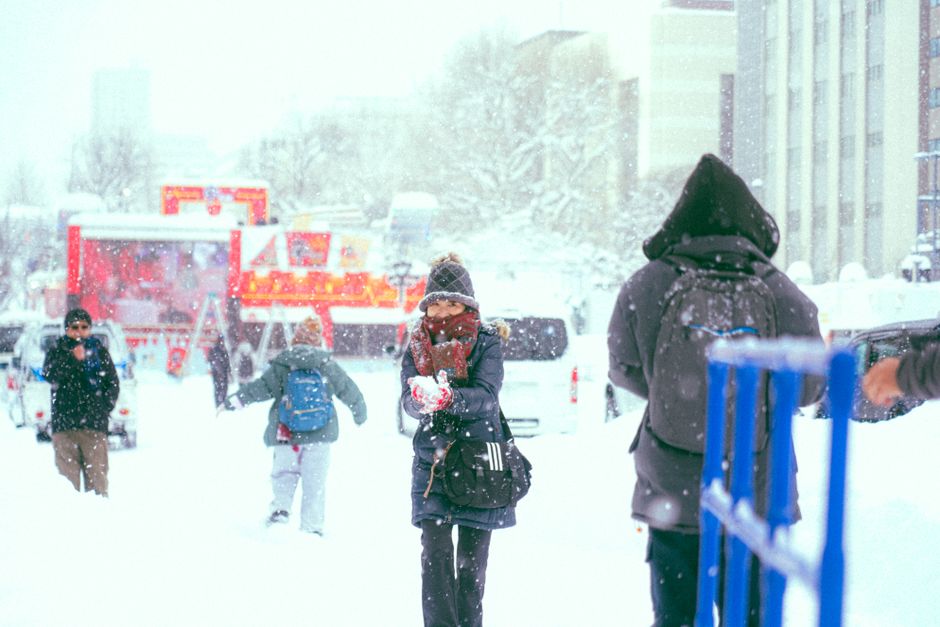
In winter, a short, practical route to the metro is often more valuable than an address that is theoretically more central. Packed snow, slippery patches and crossings can make an otherwise easy journey in good weather difficult.
The right criterion is the complete route to the transport: the building exit, pavement, entrance, any lift and access to the platform. Advertised proximity to a metro entrance does not necessarily describe a route suitable for a pushchair or large suitcases.
The underground walkways between Sapporo Station, Odori and Susukino
The underground network makes travel along the central axis easier, but does not guarantee a covered route to every accommodation option. Chi-Ka-Ho connects the Sapporo and Odori areas, while Pole Town extends the route towards Susukino.
These walkways reduce exposure to wind and falling snow. They also let you combine travel with eating out and shopping, which is useful when outdoor conditions deteriorate.
However, not all of them remain accessible at all times. Public passages, commercial access points and doors leading into a building may have different opening hours: check those for the routes you actually plan to take.
Nor should you confuse proximity to the network with a direct connection. A property described as being next to a shopping arcade may still require crossing a road or taking a detour to the entrance with a lift.
Identify the step-free access before you arrive, especially if you are travelling with heavy luggage. This preparation avoids discovering at the bottom of a staircase that the accessible entrance is on the other side of the crossroads.
Walking and using public transport when it snows
Allow extra time for getting around in winter. Shoes with good grip and easy-to-handle luggage make journeys more comfortable, but do not remove the difficulties caused by icy surfaces.
The metro is particularly useful for getting around the city sheltered from the weather. Regional trains and road transport are more exposed to disruption during heavy snowfall.
For an important connection or a flight, check the operator’s travel updates before setting off. Avoid basing your plans on a succession of connections with very little time to spare.
Late-night journeys require the same care: the last metros depend on the line, station and direction. Staying near busy restaurants means relying less on these timetables, without assuming that all the shopping arcades will remain open.
Snow Festival, ski season and summer: book ahead
Book early for the Snow Festival in February, the busiest ski periods and major summer events. Check the dates for the relevant edition on the official website before buying non-refundable services.
During the festival, Odori is a good choice if you want to see the sculptures at different times of day. Susukino may suit you better if you are combining the ice installations with restaurant outings.
Accommodation near the festivities is not automatically quiet. Check its aspect and proximity to the main roads, especially if you plan to turn in early.
Summer is not uniformly quiet: school holidays and events in the park also drive demand. Compare the cancellation conditions as soon as your dates become clearer, rather than waiting until an entire neighbourhood offers fewer options.
How many nights in Sapporo, and where to stay to visit Otaru, Niseko or Noboribetsu?
As a general guide, allow three to five nights to explore Sapporo and add an excursion without cramming too much into each day. Two nights is more suited to a short stop, while a longer stay becomes worthwhile if you want to alternate sightseeing, rest and regional trips.
This is a recommendation for a comfortable pace, not a compulsory minimum. Arriving late and leaving early gives you far less time on the ground than a stay with the same number of nights but daytime travel.
Two, three or five nights: choose the area to match the time available
For a short stop centred around train travel, stay near the station. You will minimise travel with your luggage and can spend more time sightseeing rather than making connections.
With three or four nights and a mainly urban itinerary, Odori provides a flexible base. It allows you to divide your days between the centre, the neighbourhoods served by the metro and a possible trip to Otaru.
For five nights or more, the facilities at your accommodation become more important. A laundry, a pleasant living area or a kitchen may make Nakajima Koen or Maruyama worthwhile, provided the extra travel fits with your itinerary.
Changing accommodation between the station and Susukino solely to save a few journeys is rarely necessary. Checking out, transporting your suitcases and settling in again can absorb the expected benefit.
Otaru from Sapporo: the excursion that favours staying near the station
Otaru is easy to visit as a day trip from Sapporo thanks to direct trains. Allow around an hour for the journey, depending on the service and arrival station, then check the timetables on the official JR Hokkaido website.
The canal, former warehouses and shopping streets make it possible to plan a full day without changing accommodation. Staying near the quays makes this outing easier, but a single excursion is not necessarily enough reason to rule out Odori or Susukino.
In winter, check travel conditions before setting off and avoid planning a return that leaves too little time before another commitment. An evening there can be enjoyable, provided you have checked which trains are available for the journey back.
Niseko: stay there for several days of skiing
If you plan to ski for several days in Niseko, choose accommodation in the mountain area rather than making daily trips from Sapporo. The transfer is considerably more demanding than a trip to Otaru and may depend on seasonal services.
Depending on where you arrive, a train journey will not take you directly to the foot of the slopes. You need to consider the complete route, including connections and the final leg by bus, shuttle or other suitable transport.
Seasonal coaches may require a reservation and serve specific stops. Check the timetables, the conditions for transporting equipment and the actual distance between your accommodation and the stop you choose.
Sapporo remains worthwhile before or after this stage for city sightseeing and restaurants. It does not replace a base at the resort when skiing is the main focus of the trip.
Noboribetsu: spend a night to make the most of the baths
Noboribetsu is worth an overnight stay if the hot springs are an important aim of your trip. The railway station and the hot-spring area are separate: you will still need to transfer by road after the train.
A day trip is possible, but it requires coordinating transport and the opening hours of baths open to outside visitors. These conditions vary between establishments and should be checked before setting off.
By staying in the hot-spring destination, you have more time for the volcanic valley and relaxation. Keep Sapporo as your urban base, but plan a stop elsewhere when transfers begin to take over the day.
Frequently asked questions about accommodation in Sapporo
Which area should you choose for your first stay in Sapporo?
Odori is generally the best compromise for combining sightseeing, the metro and restaurants. Choose the station area if you have several JR departures, or Susukino if you will mainly spend your evenings in the neighbourhood.
Can you travel directly to Sapporo from New Chitose Airport?
Yes, JR trains run directly from the airport to Sapporo Station. The journey generally takes around 40 minutes, depending on the service; check the timetable, particularly if you are arriving late or taking an early-morning flight.
Do you absolutely need to stay near the station in winter?
No. A place near an underground entrance in Odori or Susukino can be very convenient. Pay particular attention to the outdoor route, the available lifts and the opening hours of the passages you will use.
Which area of Sapporo is best for families with children?
Odori makes getting around easier, while Nakajima Koen can offer a more peaceful setting. The room layout, sleeping arrangements and step-free route to the metro are more important than the name of the neighbourhood alone.
Can you visit Otaru, Niseko and Noboribetsu while staying in the same accommodation?
Otaru is well suited to a day trip from Sapporo. For several days of skiing in Niseko or a stay focused on bathing in Noboribetsu, staying there avoids repeated transfers and gives you more time at your destination.