Odaiba Tokyo: Things to Do on the Artificial Island
Discover Odaiba, Tokyo’s artificial island: attractions, beaches, museums and bay views for a memorable waterfront escape in the capital.
To visit Asakusa in Tokyo, start at Kaminarimon Gate, walk along Nakamise-dōri to Sensō-ji Temple, then explore the nearby shrine and surrounding streets. This route connects the neighbourhood’s main sights without requiring multiple journeys. You can then extend your walk towards Kappabashi’s kitchenware shops or the Sumida riverbanks, depending on whether you are more interested in specialist shops or urban scenery.
This part of the capital combines religious practice, popular dining and souvenir shops. It retains an identity linked to the shitamachi, the historically commercial and crafts-oriented low city, but it is not an untouched old-fashioned setting: reconstruction and contemporary life are also part of the landscape.
The time of day significantly changes the experience. During the day, the stalls and places of worship set the pace of the visit; in the evening, the focus shifts towards illuminated façades and restaurants. To include this stop in a wider stay, our Tokyo guide helps place it among the other neighbourhoods worth discovering.
In brief
Kaminarimon Gate marks the best-known entrance to the route. Its large red lantern immediately attracts attention, but the protective figures associated with wind and thunder also deserve a closer look: they remind you that this architecture has a religious function beyond its role as a photographic emblem.
The passage remains a busy thoroughfare. To observe the sculptures or frame the lantern, stand to one side rather than beneath its centre; you will be able to look at the details without stopping visitors heading towards the shopping street.
Sensō-ji Temple is dedicated to Kannon, the Buddhist figure of compassion. According to the traditional foundation story, fishermen discovered a sacred representation in the Sumida, before a villager recognised its importance and encouraged its worship.
This story belongs to the religious tradition of the site and should not be presented as an event demonstrated in every detail. It nevertheless explains the symbolic link between the river, the local community and the spiritual centre around which the neighbourhood developed.
The age of this tradition does not mean that all the buildings you can see are original. Destruction and reconstruction have transformed the complex; its heritage value also lies in the continuity of its uses, the repeated architectural forms and local attachment to the site.
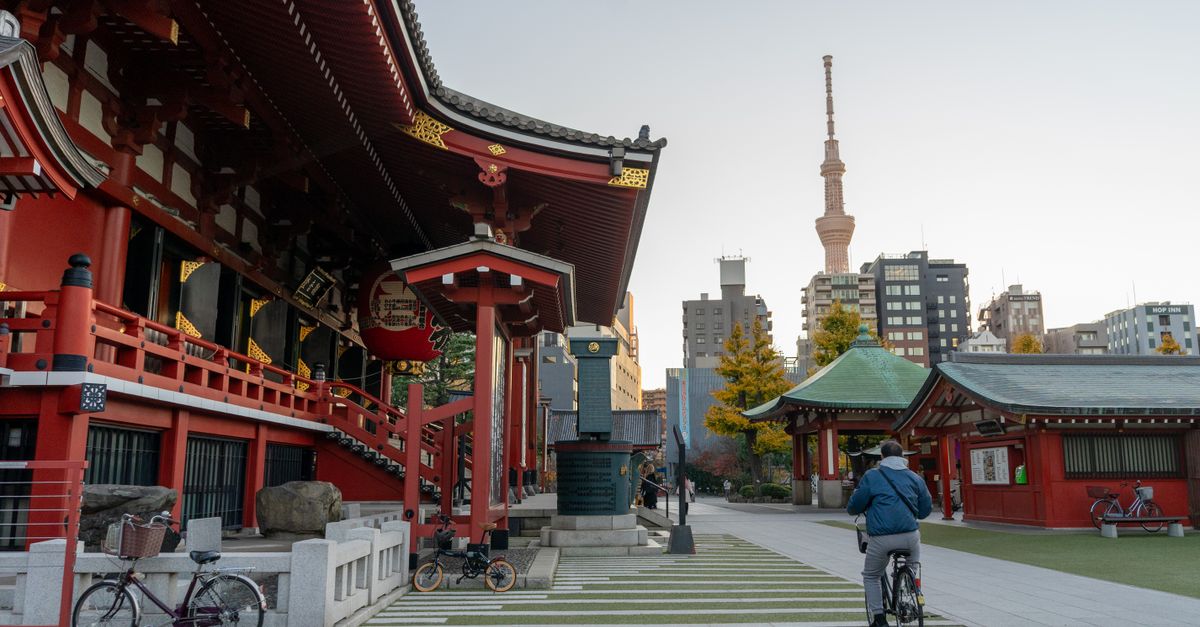
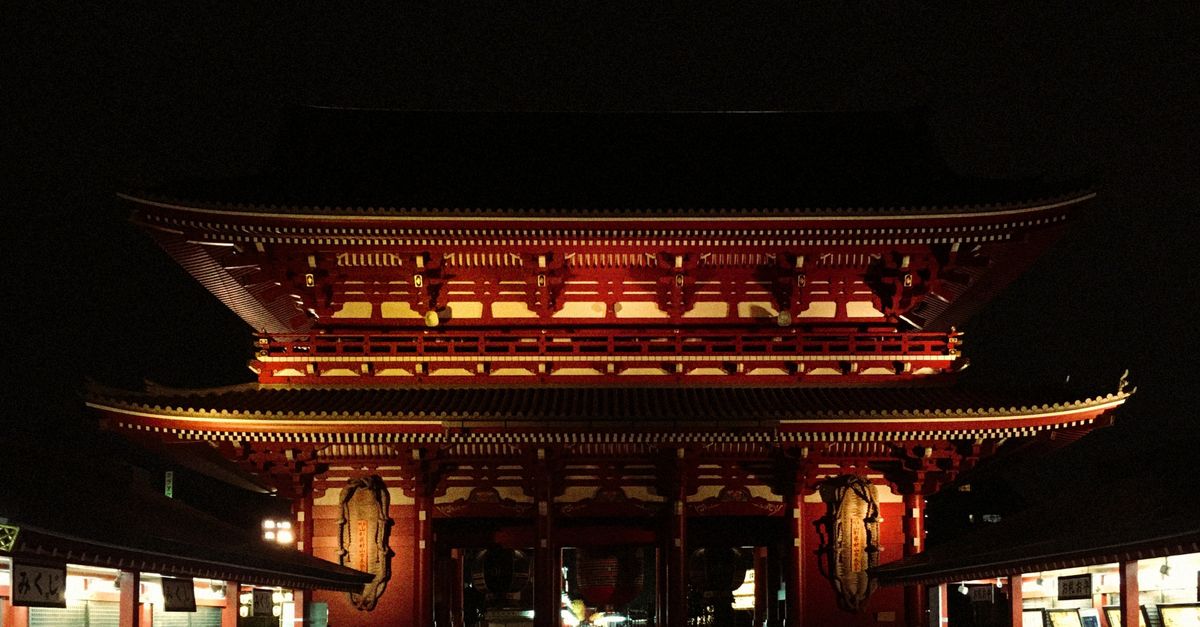
After the shopping street, Hōzōmon Gate opens onto the main area. Look at the successive volumes: the monumental passages organise the approach to the prayer hall, while the roofs and their overhanging eaves give the complex visual coherence.
The five-storey pagoda stands on the left as you walk towards the main hall from this gate. It is primarily viewed from outside; do not build your itinerary around climbing the structure or an assumed interior visit.
Inside the hall, your attention should remain focused on worship. The sacred representation at the origin of the devotion is not displayed like a museum object: coming here means discovering a place of prayer, not looking for a statue that can be photographed.
In front of the main building, the incense burner is used for devotional gestures. Some worshippers direct the smoke towards themselves according to a traditional belief; this is not a medical practice, and you do not have to reproduce the gesture to appreciate the site.
Omikuji are written fortunes drawn according to the displayed instructions. When an unfavourable fortune is tied to a designated support, this is a religious custom: avoid attaching the papers to trees, sculptures or an arbitrarily chosen feature.
Nearby, Asakusa Shrine, generally called Asakusa-jinja, is a Shinto shrine honouring the figures associated with the temple’s foundation. The ritual gestures are therefore not interchangeable: at the Buddhist temple, people usually put their hands together without clapping; at the shrine, follow the local instructions.
Our guide to religion and spirituality in Japan helps explain this proximity. The best way to visit is to observe local customs without disturbing those who have come to worship.
Nakamise-dōri connects the monumental entrance gate with the religious centre. This shopping street brings together sellers of sweets, accessories and souvenirs; its location explains the high concentration of visitors, but on its own it does not indicate the quality of every shop.
To shop without rushing, first look at the displays and return to the items that interest you. The adjacent streets usefully extend the exploration, but they are not automatically cheaper or more “authentic”: compare materials, finishes and the explanations provided.
Ningyō-yaki are small moulded cakes, often filled with sweet red bean paste called anko. Their shapes are part of their visual appeal, but the filling and texture vary between preparations; ask what the product contains rather than relying only on its appearance.
Senbei provide a savoury or sweet-and-savoury alternative. These rice crackers may be seasoned with soy sauce; thick, thin and seaweed-wrapped versions have different textures, making assortments interesting for discovering several styles.
Kibi-dango sold in the area are soft bites associated with millet, often served with roasted soya-bean powder. Their exact composition depends on the maker: if you have an allergy, ask for the ingredients to be confirmed, particularly soya, wheat or dairy products depending on the speciality chosen.
Melon-pan is recognisable by its gridded biscuit-like surface. Its name does not necessarily mean that it tastes of melon, and a cream filling is not always included; it is better understood as a family of sweet breads than as one identical recipe.
For fried products, also distinguish between the names: an agemanju is a fried manjū-style cake, not a tofu fritter by definition. Our guide to Japanese food helps you identify the main preparation families before ordering.
Japanese crafts cannot be recognised simply by a crane, cherry-blossom or wave motif. An object decorated in a traditional style may have been mass-produced; for an important purchase, ask about its origin, material and, where appropriate, the name of the workshop.
Tenugui, pieces of finely printed cotton, are easy to carry and can be used in everyday life. Look at the decoration technique and care instructions, as some dyes require care when washing; their appeal is not limited to hanging them on a wall.
For a folding fan, check that it opens evenly and that the assembly is sturdy. Ceramics require a different inspection: ask whether they are suitable for food use, how fragile they are and how they will be packed, especially if they have to travel in a suitcase.
Religious amulets, or omamori, should not be confused with every lucky charm sold in the stalls. If you want an object connected with worship, go to the temple or shrine’s distribution areas rather than a general souvenir shop.
Finally, eat your purchases in the place indicated by the seller and ask where to dispose of the packaging. On this busy street, buying and eating away from the flow of people makes the visit better for everyone.
The surrounding area gives the neighbourhood a depth that the monumental route alone does not reveal. Leaving the busiest shops behind takes you towards specialist stores, dining streets and open spaces overlooking the river: each direction offers a different experience.
You do not need to combine everything in one itinerary. Choosing between a walk focused on objects and a route towards the water avoids turning an outing on foot into a succession of journeys, especially when heat or rain slows you down.
Kappabashi is a shopping area focused on restaurant equipment, but it is also open to private customers. It sells tableware, saucepans, serving accessories and knives, among other things; its interest lies in the diversity of professional uses represented, not only in the souvenirs on offer.
Plastic food replicas, called shokuhin sanpuru, show how dishes can be presented in Japanese shop windows. Their realism is primarily intended to make an offering easy to understand: portion size, visible ingredients and arrangement become visual information before you even read a menu.
When buying a knife, explain what you cook and how you maintain your utensils. Blade shape, sensitivity to corrosion and sharpening requirements matter more than a general reputation; then check the transport rules with your airline and the applicable customs formalities.
Tableware requires a different approach. An item may look attractive but be poorly suited to your usual needs: ask whether it is dishwasher- or microwave-safe, and choose protective packaging rather than a simple bag.
The Sumida riverbanks provide a chance to step back after exploring the shops. Tokyo Skytree appears from several points in the area, but the quality of the view depends on your position, the light and the foreground obstacles.
This walk works perfectly well without going up the tower. It reveals a different urban scale, made up of bridges, buildings and river traffic, contrasting with the gates and roofs of the religious complex.
A cruise can extend the outing, provided you check the actual route. Consult Tokyo Cruise or the relevant operator for services, booking conditions, fares and possible interruptions; do not assume that a boat always serves the garden or neighbourhood you want to reach.
Hoppy Street is home to establishments where people come to drink and share dishes. The name refers to Hoppy, a malted drink often mixed with shōchū: if you do not want alcohol, ask how it is prepared rather than relying on the name alone.
Before sitting down, look at the menu and ask whether a seating charge or a small billed accompaniment applies. The relaxed atmosphere of an izakaya does not mean that every bill is calculated in the same way.
Sanja Matsuri is another marker of the area’s traditional culture, associated with the nearby shrine. To attend the processions, check the calendar with Asakusa-jinja and follow the organisers’ instructions; our guide to matsuri and Japanese festivals explains the main customs to know.
The best extension therefore depends on your interests: objects in Kappabashi, scenery along the Sumida, or socialising around restaurant tables.
Daytime is better for shopping and discovering religious practices; evening favours exterior architecture and dining. Returning after an initial visit can be worthwhile, but it does not guarantee empty sites or identical access to the buildings.
In the morning, some visitors look for easier movement around the gates. There is a trade-off: shops may not yet be open, and the breakfast you imagined on the main street may not be available when you arrive.
If architectural observation is your priority, begin with the gates and courtyard before spending time in the shops. You will better understand the organisation of the spaces, then return to the displays without repeatedly interrupting your progress towards the hall.
For a food outing or shopping, do the opposite: build your route around the opening times of the establishments you want to visit. Shopkeepers’ schedules are not the same as the temple’s, and a successful visit depends more on this fit than on a timetable presented as ideal for everyone.
| Priority | Suggested route | Useful check |
|---|---|---|
| Architecture and worship | Kaminarimon, Hōzōmon, main hall, nearby shrine | Building access and on-site instructions |
| Sweets and souvenirs | Nakamise-dōri, then the adjacent streets | Shop opening times and food ingredients |
| Tableware and kitchen goods | Temple area, then Kappabashi | Opening days of specialist shops |
| Urban scenery | Monumental gates, then the Sumida riverbanks | Weather and condition of the walkways |
| Night-time atmosphere | Complex exteriors, then restaurant streets | Lighting, access and your return journey |
At night, the lighting can highlight the lanterns, timberwork and roofs. Its operation and access to the different areas should be checked with the site administration; an outdoor walk does not automatically give access to a closed hall.
Follow the signs concerning photography, especially near prayer areas. Permission to photograph a façade does not apply automatically to a ceremony, an interior or a close-up portrait of worshippers.
In busy passages, avoid setting up equipment that blocks the flow of people. A photograph taken from the side of a gate can often include more detail while allowing other visitors to continue normally.
Spring and autumn are popular for their seasonal atmosphere, but they do not guarantee mild weather on the day you choose. Our guide to the best time to visit Japan helps put these preferences into perspective alongside the rest of your trip.
In very hot weather, alternate walking with breaks in the shade and time in accessible indoor places. The large paved areas around the buildings can make waiting uncomfortable; carry water and avoid concentrating all your outdoor stops in the same part of the day.
In the rain, umbrellas make it harder to pass one another along the busiest routes. Wear suitable shoes and protect paper or textile purchases, rather than assuming that every street on the route is covered.
Religious festivals also change how people move around: barriers, queues and reserved passageways may replace the usual route. The best itinerary is one that adapts to how the neighbourhood is actually being used, rather than imposing a rigid succession of stops.
Asakusa is served by several networks, and stations carrying this name are not all in the same place. The Ginza, Asakusa, Tōbu and Tsukuba Express lines serve the area, but the best choice depends on your starting point and precise destination.
From Shibuya, the Ginza Line reaches the neighbourhood without a change. From Shinjuku, one possible route is to take the JR Chūō Line to Kanda, then the Ginza Line; nevertheless, check the best route with the operators when you travel.
The Tsukuba Express station is further towards the shopping streets west of the complex. It may therefore suit an arrival near the restaurants or certain accommodation, while another access point will be more logical if you want to begin near the river.
Do not rely only on the name “Asakusa” in your app: also check the operator and suggested exit. If you have a pushchair, luggage or difficulty using stairs, consult the accessibility maps for Tokyo Metro, Toei or the relevant network.
Our guide to transport in Japan explains how to distinguish between the networks. If you have a rail pass, check its precise coverage rather than assuming that every metro and urban train is included.
The main hall, outdoor areas and religious counters do not necessarily operate during the same hours. Check opening times and access conditions with Sensō-ji’s administration, particularly if you want to attend a practice or return in the evening.
Shops have their own closing times, which may differ from one business to another. For a specific address, ask the establishment directly; this also applies to restaurants, whose service periods may differ from the neighbourhood’s general opening hours.
For your budget, separate transport, meals, shopping and any activities. Fortunes, amulets and particular services are separate expenses from simply walking around; check the amounts displayed on site and bring a payment method accepted by each seller.
A guide to the budget for a trip to Japan can help organise these categories. Setting a souvenir budget also prevents the small successive purchases along the shopping street from going unnoticed.
Staying in the area makes it easier to visit early in the morning or walk around after dinner. This choice is especially worthwhile if you enjoy dining streets and want to explore the eastern part of the capital; it is less suitable if all your outings are elsewhere.
Compare the actual address, the most convenient station and the route you will need to take with your luggage. The description “near Sensō-ji” does not tell you whether a hotel suits your travel plans, or whether getting there involves stairs or congested passages.
For a Japanese-style inn, look closely at the bedding, bathrooms and bathing arrangements. An establishment with tatami is not automatically equipped with an onsen: a communal bath does not, by itself, mean that the water is thermal.
If you want to extend the cultural experience, a Japanese calligraphy activity can complement the visit, provided you check its address and booking arrangements. Choose your base and activities according to your actual routes, rather than the neighbourhood’s reputation alone.
Sensō-ji is a Buddhist temple dedicated to Kannon. Asakusa-jinja is a nearby Shinto shrine associated with the figures in the temple’s foundation tradition. Their religious practices are distinct.
The evening is suitable for discovering the exteriors and restaurants, but it does not replace a visit to the shops and main hall. Check access and the lighting arrangements with the temple before travelling.
Ningyō-yaki filled with red bean paste, senbei rice crackers and kibi-dango are among the specialities to look for. Recipes vary: ask about ingredients if you have an allergy and eat in the place indicated by the seller.
Kappabashi suits people interested in tableware, kitchen utensils and food replicas. The Sumida riverbanks are better for walking and urban views, particularly towards Tokyo Skytree. Choose according to your interests and the weather.
Follow the signs in each area, especially near the hall and altars. Do not assume that permission to photograph outside applies to interiors or ceremonies, and avoid taking close-up photographs of worshippers without their consent.
Updated on 15/10/2026
Scroll to see more articles →